The main guide
How alimony is calculated in India
There is no formula. Anyone who tells you there is one is selling something. What there is instead is a list of factors, one rough benchmark, and a great deal of discretion.
You want a number, not a lecture. The estimator applies these same factors to your figures and shows you the judgements nearest your facts.
Calculate your maintenance →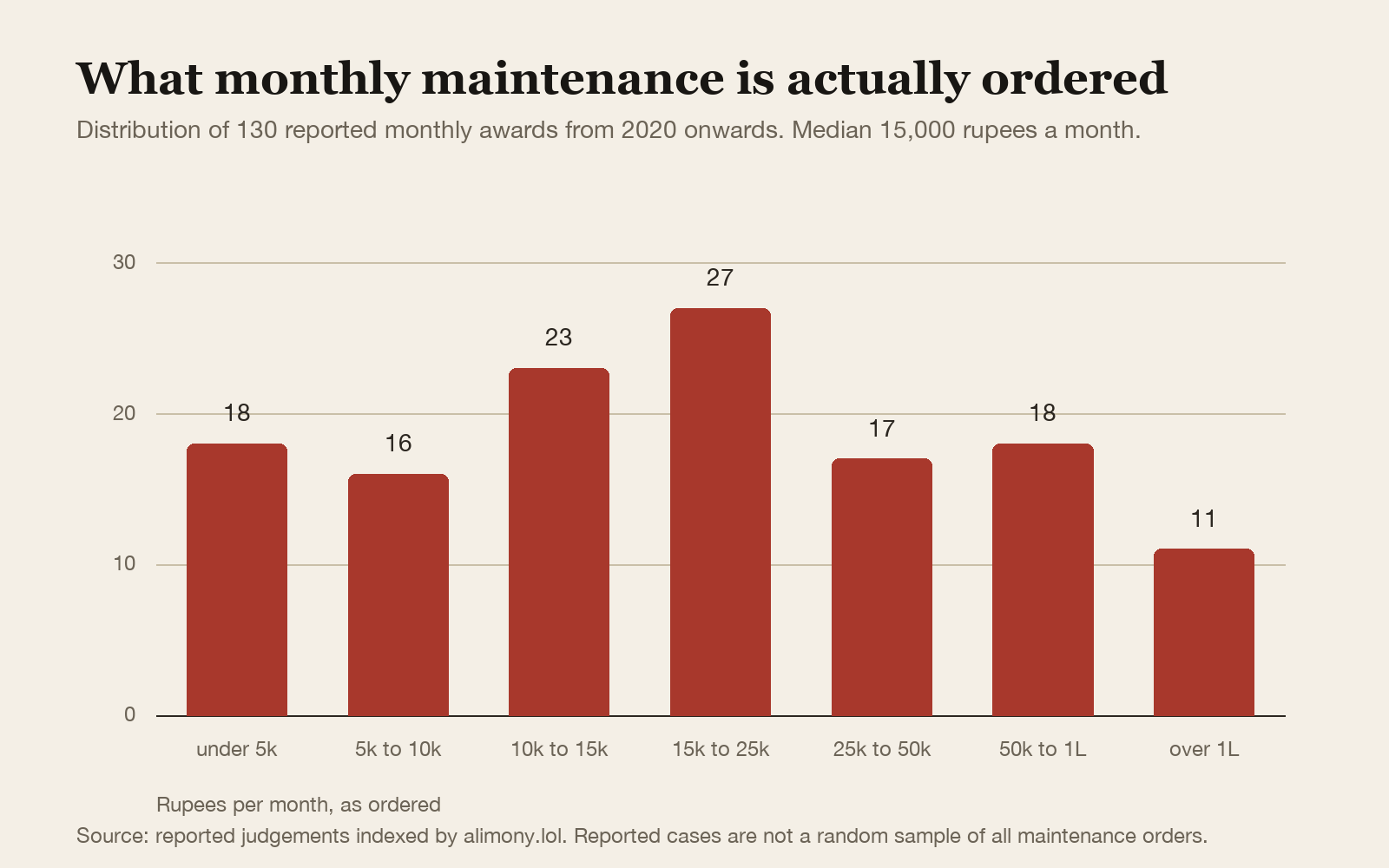
The short answer
Indian courts do not calculate maintenance. They assess it. There is no statutory formula anywhere in the Hindu Marriage Act, in Section 125 of the old Criminal Procedure Code, or in its replacement at Section 144 of the Bharatiya Nagarik Suraksha Sanhita. A judge hears both sides, works through a list of considerations, and arrives at a figure.
That said, the figure is not random. Across the reported judgements the same rough proportion keeps appearing, and if you want one sentence to hold on to, it is this one:
The benchmark Around a quarter of the husband's net monthly income, adjusted up or down for the length of the marriage, the number of children, and whether the wife has an income of her own.
The Supreme Court put that figure on the record in Kalyan Dey Chowdhury v. Rita Dey Chowdhury in 2017, upholding a High Court view that 25 percent of net salary was just and proper. The idea is older than that. It goes back to Dr. Kulbhushan Kumar v. Raj Kumari in 1970, which is still the case everyone cites for the proportion.
Treat it as a starting point that gets argued away from, not as an entitlement.
The nine factors from Rajnesh v. Neha
In November 2020 the Supreme Court decided Rajnesh v. Neha, and it is the closest thing India has to a maintenance rulebook. The judgement set out what a court is supposed to weigh when fixing quantum. Every maintenance order made since is meant to work through this list.
- The status of the parties, meaning the standard of living the marriage actually ran at
- The reasonable needs of the wife and of any dependent children
- Whether the applicant is educated and professionally qualified
- Whether the applicant has an independent source of income
- Whether that income is enough to maintain the standard of living she had in the matrimonial home
- Whether she was employed before the marriage
- Whether she worked during the marriage
- Whether she gave up work to raise children or care for the family
- The reasonable cost of the litigation itself, for an applicant who is not working
Two of those do more work than the rest. Factor five is why a working wife can still be awarded maintenance: the question is not whether she earns, it is whether what she earns keeps her at the standard the marriage ran at. Factor eight is why a long marriage costs more than a short one. A woman who left a career at twenty six to raise children cannot simply restart it at forty six, and courts say so.
The judgement also settled some things that used to be argued every time. The financial position of the wife's parents is irrelevant, so a wealthy father is no answer to a claim. Both sides must file an affidavit of assets and liabilities. And maintenance normally runs from the date the application was filed, not the date the order was finally made, which after four years of litigation is a very large difference.
The calculator walks through the same nine factors and weights them the way the reported judgements do.
See what they add up to →What actually moves the number
The gap between the two incomes
Not his income alone. The gap. A husband earning Rs 1,20,000 against a wife earning Rs 90,000 is a very different case from the same husband against a wife earning nothing, and the orders look nothing alike.
How long the marriage lasted
Under three years, courts tend to look at need. Over fifteen, they look at restoring a standard of living, and lump-sum settlements start appearing instead of monthly orders.
Who the children live with
Child maintenance is a separate head of claim and it is not optional. Rajnesh v. Neha was explicit that it has to cover schooling, coaching and vocational courses, not just food and clothes.
Whether his declared income is believable
This is where most contested cases are actually fought. Salaried men have a payslip and limited room to argue. Businessmen and professionals do not, and courts routinely look past a declared figure to lifestyle, foreign travel, property and company filings. A man who declares Rs 40,000 a month and drives a car worth thirty lakh is going to be assessed on the car.
The figure the older judgements hide
If you go looking for precedent yourself, you will hit a trap that catches almost everyone. Old awards look absurdly small. A 1985 order for Rs 500 a month reads like a rounding error. It was not.
Consumer prices in India have risen roughly sixteen times over since 1985. That Rs 500 is about Rs 8,100 a month in today's money. Read the other way, an award you think is generous today will look trivial in thirty years, which is one of the arguments for a lump sum instead of a monthly order.
Every award figure on this site carries its equivalent in today's money underneath. We have not found another Indian alimony site that does this, and it changes how most of the older case law reads. There is a fuller note on the method.
Which law you are claiming under
The route matters, because it decides the forum, the speed and sometimes the ceiling. Most people have more than one route open and can use them together.
| Route | Who it covers | Where it is heard |
|---|---|---|
| Section 125 CrPC, now Section 144 BNSS | Anyone, regardless of religion | Magistrate |
| HMA Sections 24 and 25 | Hindus, Buddhists, Jains, Sikhs | The court hearing the divorce |
| Special Marriage Act, Sections 36 and 37 | Civil and interfaith marriages | District court |
| Muslim Women (Protection of Rights on Divorce) Act 1986 | Divorced Muslim women | Magistrate |
| Domestic Violence Act 2005, Section 20 | Any woman in a domestic relationship | Magistrate |
Claims under different statutes can overlap. Rajnesh v. Neha requires you to disclose the others and lets a court adjust an earlier award against a later one, so running three parallel claims does not multiply the money.
Questions people actually ask
Is there a fixed percentage for alimony in India?
No. Twenty five percent of the husband's net monthly salary is the benchmark courts reach for most often, and the Supreme Court approved it in Kalyan Dey Chowdhury v. Rita Dey Chowdhury (2017). It is a starting point, not a rule, and it moves for the length of the marriage, the number of children and the wife's own income.
Can a working wife claim maintenance?
Yes. The test is not whether she earns but whether what she earns lets her maintain the standard of living she had in the marriage. That is factor five in Rajnesh v. Neha and it is why earning wives are regularly awarded maintenance.
From what date is maintenance payable?
From the date of the application, as a default. Rajnesh v. Neha made backdating the norm rather than the exception, which after several years of litigation can amount to a very large arrears figure.
Can a husband claim maintenance from his wife?
Under Section 24 of the Hindu Marriage Act, yes, because that section is worded neutrally. Under Section 125 CrPC, no, because it covers a wife, children and parents only. Awards to husbands are rare in practice.
Does alimony stop if she remarries?
Permanent alimony under Section 25 of the Hindu Marriage Act can be varied or rescinded if the recipient remarries. Child maintenance is unaffected, because it belongs to the child rather than to the parent receiving it.
This page summarises a reported judgement for general information. It is not legal advice and it is not a substitute for reading the judgement itself or speaking to a lawyer about your own facts.
An estimate takes about ninety seconds. No sign-up, nothing stored against your name.
Calculate your maintenance →