Method note
Reading old awards properly
Precedent is quoted in the money of its own year, which makes most of it misleading. This is the correction, and the arithmetic behind it.
Every figure on this site carries its value in today's money. The estimator does the same with yours.
Calculate your maintenance →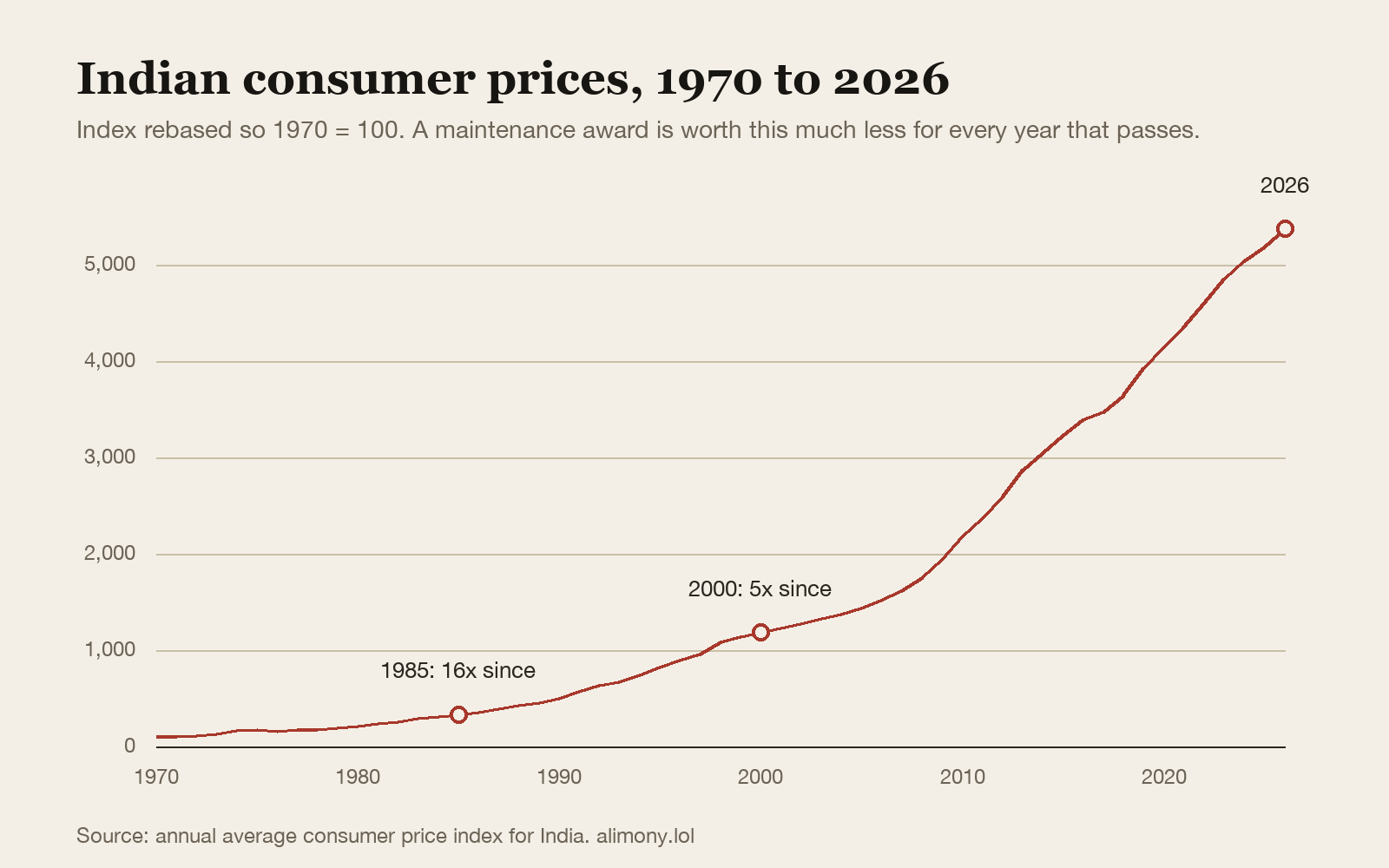
The problem
Search for alimony precedent in India and you will find figures like Rs 250 a month, Rs 500 a month, Rs 1,000 a month. They look like a different planet. People read them and conclude either that Indian courts award nothing, or that the case is too old to be useful.
Both conclusions are wrong, and they come from the same mistake: reading a rupee figure from 1970 as though it were a rupee figure from today.
The scale of it Consumer prices in India have risen roughly 53 times over between 1970 and 2026. An award of Rs 250 a month in 1970 is worth about Rs 13,400 a month now. It was never a small order.
What we do about it
Every rupee figure in our dataset carries a second figure: the same amount restated in today's money. The nominal number stays exactly as the court wrote it, because that is the fact of record and changing it would be dishonest. The adjusted figure sits underneath.
The arithmetic is the standard one. An amount from year Y becomes, in base-year terms, the amount multiplied by the price index for the base year divided by the price index for year Y. We use annual average consumer prices for India, rebased so that 1970 equals 100.
A few reference points, so you can sanity check it against your own memory of prices:
| Award | Year made | Worth today | Factor |
|---|---|---|---|
| Rs 250 a month | 1970 | Rs 13,430 | 53.7x |
| Rs 500 a month | 1985 | Rs 8,125 | 16.2x |
| Rs 5,000 a month | 1997 | Rs 28,018 | 5.6x |
| Rs 18,000 a month | 2004 | Rs 70,179 | 3.9x |
| Rs 20,000 a month | 2011 | Rs 45,381 | 2.3x |
| Rs 10,000 a month | 2010 | Rs 24,701 | 2.5x |
Where this changes the answer
Shah Bano is the clearest example. The award at the centre of the most consequential maintenance case in Indian history was Rs 179.20 a month. Quoted flat, it sounds like the courts were not serious. Restated, it is about Rs 2,900 a month, which for a divorced woman in 1985 was a real, if modest, sum. The politics of that case make more sense once the number does.
It also cuts the other way. A monthly order made today and never revised will lose most of its value over a long payment period. That is a live argument for a lump-sum settlement under Section 25 of the Hindu Marriage Act rather than a monthly order, and it is worth putting to a court in those terms.
What this is not
General consumer prices are a blunt instrument. They do not track school fees, medical costs or urban rent, all of which have risen faster than the basket over most of this period. So an adjusted figure is an order of magnitude, not a valuation.
Two further limits worth being straight about. Different Indian price series disagree with each other, particularly before 2000, because the CPI methodology changed and the older industrial-worker and agricultural-labourer series were never designed to be spliced. And no inflation adjustment tells you what a court would order today on the same facts, because the law itself has moved since. Rajnesh v. Neha did more to change quantum than thirty years of price rises did.
Questions people actually ask
Where does the inflation data come from?
Annual average consumer price index figures for India, rebased so 1970 equals 100. The implied rise from 1970 to 2026 is about 53.7 times, an average of roughly 7.4 percent a year, which matches the independently reported long-run average for India.
Does the court do this adjustment?
Not formally. Courts hearing an application to enhance an existing order do take the fall in the value of money into account, and that is one of the standard grounds for seeking enhancement, but there is no statutory indexation of maintenance in India.
Can I ask for my maintenance to be increased because of inflation?
Yes. Section 25(2) of the Hindu Marriage Act allows a court to vary an order if there is a change in circumstances, and a long-standing order losing real value is a recognised ground for applying.
This page summarises a reported judgement for general information. It is not legal advice and it is not a substitute for reading the judgement itself or speaking to a lawyer about your own facts.
An estimate takes about ninety seconds. No sign-up, nothing stored against your name.
Calculate your maintenance →